Showing posts with label HOMEPAGE. Show all posts

Wednesday, May 23, 2018

Dear Parents These Are The 3rd Science Sheets


Review and Test Preparation 3
Vocabulary Review
Use the terms below to complete the sentences. 


1. To run a machine, electricity must move along a closed _______.

2. A machine that uses a magnet to make a current of electricity is called a _______.
3. Current that moves in a wire is called _______.

Check Understanding
Write the letter of the best choice.

4. Which term describes copper?
A. circuit

B. conductor
C. insulator

D. magnet

5. What is lightning an  example of?
F. a magnet
G. an electromagnet
H. static electricity
J. a circuit

6. Miguel plugs his desk lamp into an outlet. What type of electricity is the lamp using?
F. current

G. lightning
H. magnetic

J. static

7. Plastic is an example of which of the following?
A. conductor
B. generator
C. insulator
D. magnet


8. What makes a refrigerator’s motor do work to keep food cold?
F. Current electricity
G. lightning
H. insulator
I. static electricity


9. Which is an example of electricity?
A. brush                   C. cloud
B. hair                      D. lightning


Answer the following
10. What makes a refrigerator’s motor  work to keep food cold?


Dear Parents 

These are the 2nd Science Sheets

Review and Test Preparation 2


1- COMPARE AND CONTRAST    Compare the four areas on the diagram below.
Which area is the warmest?


A. Area 1

B. Area 2

C. Area 3

D. Area 4


2. The movement of Earth once around the sun is called a _____.

3. A group of stars that appears to form a picture is a _______.

4. The imaginary line Earth rotates around is known as its _______.

5. A large body of rock or gases that orbit the sun is a _______.

6. The sun, the planets, and the other objects that orbit the sun make up the _______.


Check Understanding
Write the letter of the best choice.
7. Which of the following is responsible for Earth’s seasons?
A. Earth’s rotation
B. Earth’s tilt
C. solar eclipses
D. the lunar cycle

8. Which of the following is responsible for day and night?
F. Earth’s orbit
G. Earth’s revolution
H. Earth’s rotation
J. Earth’s tilt

9. About how long is the lunar cycle?
F. 29 days
G. 365 days
H. 24 hours
J. 1 week


10. Which of the following is true about Mercury?
A. It has plenty of water.
B. It is far from the sun.
C. It is made of frozen gases.
D. It is very hot.
11. Which of the following is true about Venus?
F. It has two moons.
G. It is the closest planet to the sun.
H. Its rotation is in the opposite direction to the rotations of the other planets.
J. Its day lasts only 11 hours.

12. Infer why animals and plants are found on Earth but not on other planets of the solar system.


--------------------------------------------------------------------------------------------------------


Tuesday, May 22, 2018


Dear Parents
These are the first 2 sheets in the science Final Revision.

Review and Test Preparation 1
Vocabulary Review

Match the terms to the definitions below.

rock 

1. Trace or remains of a living thing that died long ago

2. Rock that was once melted and then cooled and hardened

3. An object that is solid, has never been alive and was 

formed in nature

4. A rock formed from a material that settled in layers

5. A solid made of one or more minerals

6. A rock changed by heat and pressure


Check Understanding

Write the letter of the best choice.

7. MAIN IDEA AND DETAILS Which tells a way most minerals are identified?

A. beauty
B. heat

8. COMPARE AND CONTRAST How are casts different from molds?
F. Casts are only found in the mantle.
G. Casts are plant fossils. Molds are animal fossils.
H. Casts are materials that fill up a mold.
J. Casts are fossils. Molds are not.


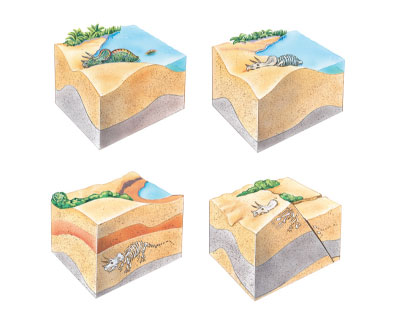
9. Which do the drawings show?


A. how a fossil forms

B. how a mineral forms

C. how igneous rocks form

D. how to classify kinds of rocks

10. Which is most important in forming igneous rocks?

F. fossil models

G. melting

H. cool temperatures

J. dead plants and animals

11. Which is an imprint fossil?

A. a petrified tree

B. a dinosaur footprint

C. a dinosaur bone

D. an insect trapped in sap

12. Which process is shown in the drawing?


F. how sediments build up

G. how imprint fossils form

H. how metamorphic rocks form

J. how sandstone forms

13. Which would be needed to form sedimentary rocks?

A. a volcano

B. casts and molds

C. pressure and temperature

D. wind and water


14. Which is not a way to identify a mineral?

F. by its outside color

G. by its hardness

H. by doing a streak test

J. by trying to break it

15. What is the hardest mineral on the Mohs Scale?

A. apatite

B. copper

C. diamond

D. talc

16. Which could a scientist infer about a place that has fish fossils?

F. The place was once land.

G. That place is a sea now.

H. That place was once a sea.

J. The fish did not live in water.


C. smell
D. streak


Saturday, April 28, 2018

Electrical Circuits - Series and Parallel -For Kids

Conductors and Insulators -Animation for kids

Chapter 13: Electricity and Magnets
Lesson 1: What Is Electricity?
VOCABULARY
Static electricity
Current electricity
Circuit


Static Electricity
On a cold day, you may see a person’s hair stand up straight. The reason the hair stands up is static electricity. Static electricity is an electric charge that builds up in an object.
Lightning is one example of static electricity. A static charge builds up in a cloud, and then current electricity moves to the ground in the form of a lightning flash. You may even hear a crackling noise.


What happens when you plug a lamp into a wall outlet? Electricity flows from wires in the wall through the plug and into the lamp’s wires. Electricity that moves through a wire is current electricity.
A lamp’s bulb glows only when there is a closed circuit. A circuit is a path that electricity follows. Electricity moves from the wall outlet, through the lamp, and back to the wall.
People use current electricity to light, heat, and cool homes, to run motors, and to cook food. What other things do you know of that use electricity?


MAIN IDEA AND DETAILS What is current electricity?


How Electricity Moves
Electricity moves through some things but not through others. Something that electricity moves freely through is called a conductor. Copper wire is a good conductor.
Something that electricity will not move through easily is called an insulator. Wood and plastic are examples of insulators. Electricity can be dangerous, so people use insulators to stay safe.

MAIN IDEA AND DETAILS    What is a conductor? What is an insulator?


This week we will finish the Multiplication tables. so it is time to study all the Multiplication tables from 1-12.

Saturday, April 21, 2018

The 8 Times Table Song (Multiplying by 8) | Silly School Songs

The 7 Times Table Song (Multiplying by 7) | Silly School Songs

The 6 Times Table Song (Multiplying by 6) | Silly School Songs


It is time to study Multiply by 6, by 7 and 8

Last week we started a new chapter in science.  This week we will go on.

Lesson 2: What Are Forces?
VOCABULARY


Types of Forces
To move a ball, you can throw it, kick it, or hit it with a bat. Any kind of push or pull is a force. You must apply a force to make an object move. An object will keep moving until another force stops it. When you catch a moving ball, the force from your hand stops the ball.

Friction is one force that stops things or slows them down. When two objects rub together, there is friction between them. Most rough surfaces make more friction than smooth surfaces. You can slide farther on the ice than you can on dirt or grass.

Forces also make objects change directions. You apply a force to the handlebar to turn your bike. When you push one end of a seesaw down, the other end comes up.
Some forces do not even have to touch the object. A magnet can be used to push or pull objects made of iron or steel. This is called magnetic force. A magnet can pull a nail.

MAIN IDEA AND DETAILS A magnet picks up paper clips. What force is at work?


Ways That Forces Change Motion
Three things affect the motion of an object.
• the strength of the force
• the direction of the force
• the mass of the object
The stronger the force is, the greater the change in motion. If you toss a ball gently, it doesn’t move fast or far. If you throw a ball hard, the ball moves faster and farther. You use more force on the ball when you throw it as hard as you can.

If an object is not moving and a force pushes or pulls it, the object will move in the direction of the push or pull. When you pull up on an object, it comes up. When you push an object to the right, it moves to the right.
The smaller the mass of an object is, the easier it is to move. It takes less force to pick up a pencil than to pick up a book since a pencil has less mass.


You can add all the forces that push or pull on an object. The sum is called the net force. Suppose you and a friend push the same way on a door. The net force on the door equals your push plus your friend’s push.


MAIN IDEA AND DETAILS Name three things that affect the motion of an object and tell what each one does.


When equal forces act in opposite directions, they cancel each other out. The net force is zero.

Why does the waterfall back down to Earth after shooting up from the fountain?


Gravity
When you throw a ball into the air, you know that it will come back down. Gravity is a force that pulls two objects toward each other. The ball comes back to Earth because Earth’s gravity pulls on it.
Gravity is a very weak force between most objects. You don’t feel the force of gravity between you and your desk. But Earth’s gravity pulls very strongly. This is because Earth is so large.


The force of gravity depends on how much mass an object has. Weight is a measure of the force of gravity on an object. Objects with a large mass weigh more.

MAIN IDEA AND DETAILS Does gravity pull a horse or a puppy harder? How do you know?